Dubai Luxury Market 2026: Wealth, Private Services, Luxury Shopping & Lifestyle Trends
Dubai's luxury economy in 2026 extends far beyond designer boutiques, supercars and five-star hotels.
The emirate has developed an interconnected premium ecosystem spanning ultra-prime residential property, luxury retail, fine dining, wellness and longevity, private aviation, yachting, jewellery and watches, beauty and aesthetics, bespoke travel and specialist private services.
Several measurable trends help explain this development: Dubai achieved record international visitation in 2025, transactions at the very top of its residential property market remained strong into 2026, the UAE wellness economy continued to expand, and Dubai has been actively developing its digital-commerce infrastructure.
This Pearl Circle market overview examines those indicators and what they reveal about the direction of Dubai's luxury economy in 2026.
Dubai Luxury Market 2026: Key Indicators
Market Indicator Latest Reported Figure
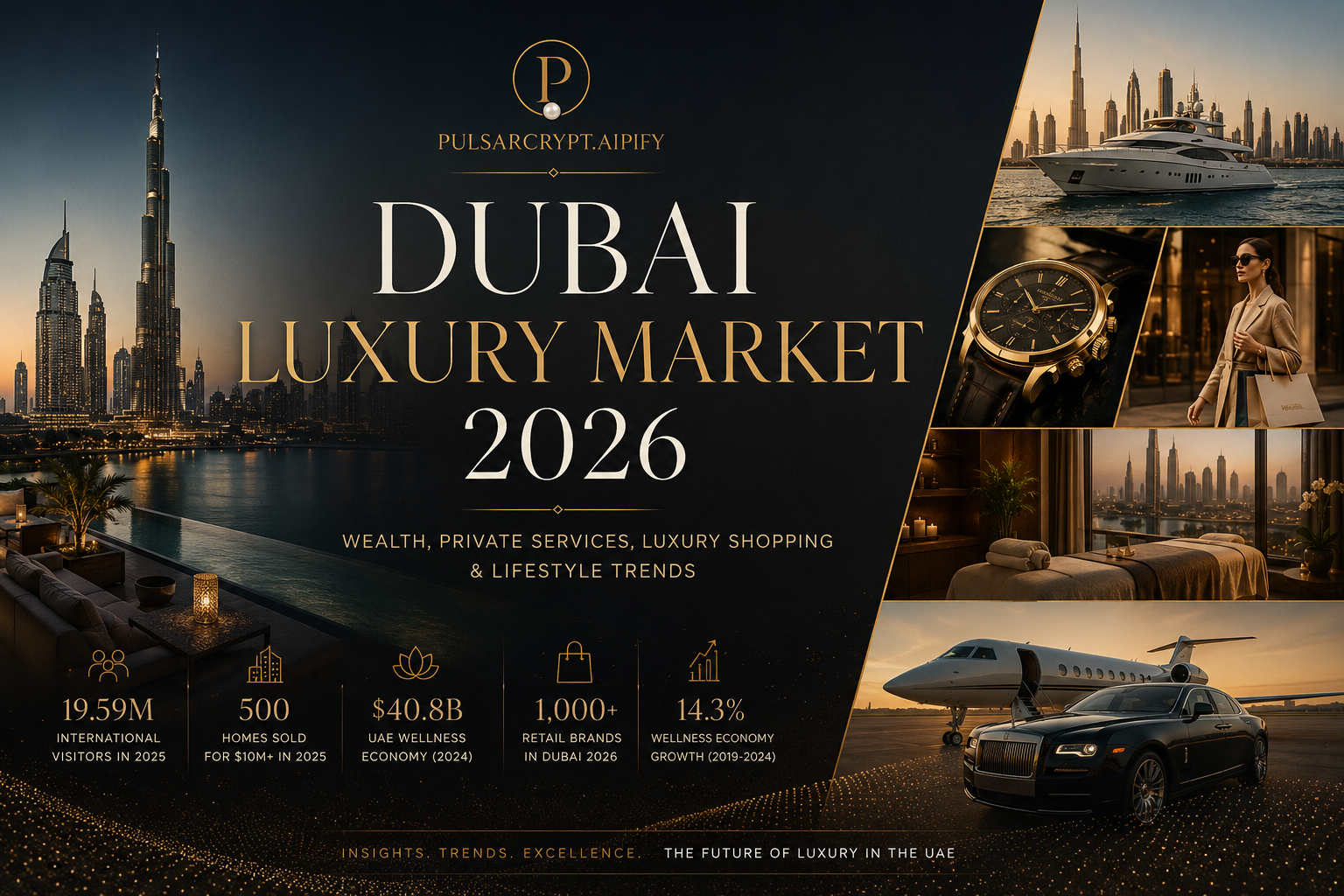
Dubai international overnight visitors in 2025 19.59 million
Visitor growth compared with 2024 5%
Dubai homes sold above US$10 million in 2025 500
Value of US$10m+ home sales in 2025 US$9.05 billion
Dubai US$10m+ home sales in H1 2026 296
Value of H1 2026 US$10m+ transactions US$5.1 billion
UAE wellness economy US$40.8 billion
UAE wellness tourism economy US$11.3 billion
New e-commerce sellers supported by Dubai Traders in its first year 2,400+
Important: These figures represent different sectors, geographic scopes and reporting periods. They should not be combined to calculate a single value for Dubai's overall luxury market.
Instead, they provide indicators of activity across tourism, ultra-prime property, wellness and digital commerce.
- Dubai Recorded 19.59 Million International Visitors in 2025
International tourism remains one of the foundations of Dubai's premium economy.
According to the Dubai Department of Economy and Tourism (DET), Dubai welcomed a record 19.59 million international overnight visitors in 2025, representing approximately 5% growth compared with 18.72 million visitors in 2024.
December 2025 was particularly significant, becoming the first month in which Dubai welcomed more than two million international visitors.
Source:
Dubai Department of Economy and Tourism – Dubai's tourism industry achieves third successive record-breaking year
Tourism matters to the luxury economy because international visitors generate demand across multiple interconnected sectors, including:
luxury hospitality;
fine dining;
luxury shopping;
wellness and spa services;
private transportation;
premium experiences;
jewellery and watches;
beauty and aesthetics;
yacht and marine experiences;
luxury travel services.
Dubai's economic ambitions also extend well beyond tourism.
The Dubai Economic Agenda D33 aims to strengthen Dubai's position among the world's leading cities while expanding economic activity, international trade, investment and digital transformation.
Source:
Dubai Department of Economy and Tourism – D33 and strategic initiatives
The combination of residents, international visitors, investors, entrepreneurs and globally mobile affluent consumers creates an unusually diverse customer base for premium businesses.
- Ultra-Prime Property Demonstrates High-Value Demand
Dubai's residential property market provides one of the clearest measurable indicators of activity among wealthy buyers.
According to Knight Frank, Dubai recorded 500 residential transactions valued above US$10 million during 2025.
The combined value of those transactions reached approximately US$9.05 billion, while 68 transactions exceeded US$25 million.
Source:
Knight Frank – Dubai US$10 million-plus residential sales, 2025
Activity remained strong during 2026.
Knight Frank reported 296 residential transactions above US$10 million during the first half of 2026, with a combined value of approximately US$5.1 billion.
Twenty-six of those transactions exceeded US$25 million.
Source:
Knight Frank – Dubai US$10 million-plus residential sales analysis, H1 2026
Ultra-prime property activity is relevant beyond real estate itself.
Ownership of high-value residences can generate adjacent demand for specialist services such as interior design, art advisory, household staffing, estate management, private chefs, landscaping, security, transportation, wellness and home technology.
This helps illustrate why Dubai's luxury economy should be considered an ecosystem rather than a collection of individual luxury-product categories.
- Dubai Luxury Is Increasingly About Services as Well as Products
Luxury has traditionally been associated with physical goods: fine jewellery, watches, couture, automobiles, art and collectible objects.
Those categories remain important.
However, a significant part of the contemporary premium economy also revolves around services, expertise, experiences, convenience and access.
Examples include:
private aviation;
yacht charter and marine services;
private chefs and culinary experiences;
luxury travel planning;
personal styling;
beauty and aesthetic services;
wellness and longevity programmes;
household and estate services;
private security;
art and interior advisory;
specialist luxury property services;
invitation-only experiences.
This distinction matters because measuring luxury solely through retail sales does not capture the complete premium consumer economy.
An affluent household may purchase a luxury watch while simultaneously using a private chef, wellness specialist, yacht operator, interior designer and bespoke travel adviser.
Modern luxury consumption therefore increasingly moves between products, services and experiences.
- The UAE Wellness Economy Has Reached US$40.8 Billion
Wellness has become one of the most important areas of the UAE premium lifestyle economy.
According to the Global Wellness Institute (GWI), the UAE wellness economy reached approximately US$40.8 billion, based on 2024 data.
The organisation identified several substantial segments:
Personal Care & Beauty — US$14.8 billion
Wellness Tourism — US$11.3 billion
Spa Revenue — US$2.9 billion
Wellness Real Estate — US$1.4 billion
GWI also reported that the UAE wellness economy grew at an annual rate of approximately 14.3% between 2019 and 2024.
Source:
Global Wellness Institute – UAE wellness economy reaches US$40.8 billion
These figures demonstrate why wellness now intersects extensively with the premium and luxury sectors.
For affluent consumers, wellness can encompass considerably more than an occasional spa treatment.
The category increasingly includes:
preventative wellness;
longevity;
personalised fitness;
recovery;
nutrition;
advanced beauty treatments;
aesthetic medicine;
wellness retreats;
sleep optimisation;
specialised health services.
This convergence between wellness and luxury is likely to remain an important part of the UAE premium consumer landscape.
- Dubai's Retail Market Is Becoming More Experiential
Dubai remains one of the world's most recognised shopping destinations.
However, the city's retail proposition increasingly extends beyond conventional transactions.
The Dubai 2026 Retail Calendar integrates shopping with entertainment, gastronomy, fitness, cultural experiences and major citywide campaigns.
According to DET, more than 1,000 brands and 4,000 retail outlets are expected to participate across the calendar.
Source:
Dubai Department of Economy and Tourism – Dubai unveils 2026 Retail Calendar
This development is particularly relevant for premium retailers.
Consumers can discover and compare products online before entering a physical boutique. As a result, physical luxury environments increasingly have to deliver value beyond simple product availability.
That can include:
exceptional service;
specialist expertise;
personalisation;
private appointments;
exclusivity;
hospitality;
storytelling;
memorable experiences.
The distinction between retail and experience is therefore becoming increasingly blurred.
- Digital Commerce Is Becoming Part of Dubai's Retail Infrastructure
Dubai's premium retail ecosystem is also becoming more digital.
The Dubai Traders initiative, part of D33, supported more than 2,400 new e-commerce sellers during its first year, according to DET and Dubai Chambers.
Source:
Dubai Department of Economy and Tourism – Dubai Traders supports more than 2,400 new e-commerce sellers
The programme supports businesses seeking to establish or expand their digital presence.
For luxury retail, however, digital transformation does not necessarily mean competing primarily on price or catalogue size.
A premium digital-commerce proposition can instead emphasise:
Discovery → Curation → Confidence → Convenience → Service
This becomes particularly important as consumers face an ever-increasing number of products, marketplaces and providers.
For some consumers, the premium is no longer simply access to more choice.
It is access to better-filtered choice.
- Fine Dining Is Part of Dubai's Premium Lifestyle Economy
Gastronomy has become another important component of Dubai's international positioning.
Dubai now supports an extensive range of internationally recognised restaurants, celebrity-chef concepts, destination dining experiences and Michelin-recognised establishments.
The official Dubai city guide provides information about the city's evolving restaurant and hospitality landscape.
Source:
Visit Dubai – Official Dubai City Guide
Fine dining demonstrates an important characteristic of contemporary luxury:
The value being purchased is not necessarily a physical object.
Consumers may instead be purchasing service, atmosphere, expertise, scarcity and experience.
This same principle applies to private dining, luxury travel, wellness retreats, yacht charters and other premium experiences.
- Why Dubai Supports a Broad Luxury Ecosystem
There is no single explanation for Dubai's development as a luxury destination.
Several structural factors work together.
International Connectivity
Dubai is a major international aviation, tourism and business hub connecting Europe, Asia, Africa and the Middle East.
International Tourism
Record visitor numbers support demand across hotels, restaurants, retail, transportation, experiences and wellness.
Ultra-Prime Residential Demand
Activity in the US$10 million-plus residential market demonstrates substantial high-value property demand.
Business Infrastructure
D33 and related initiatives seek to expand Dubai's economy, international business activity and digital capabilities.
Retail Infrastructure
Dubai combines major shopping destinations with luxury boutiques, jewellery, watches, fashion and experiential retail.
Hospitality
Luxury hotels, resorts, restaurants and destination experiences provide substantial premium lifestyle infrastructure.
Specialist Services
Private transportation, aviation, yachting, household services, security, wellness and other specialist providers complement traditional luxury retail.
Together, these factors create an ecosystem in which luxury expenditure can move across:
Property + Products + Services + Experiences
- The Luxury Consumer's New Problem: Too Much Choice
Digital platforms have made luxury products and services easier to discover.
But this accessibility has created another problem:
information overload.
A search for a private chef, yacht provider, aesthetic clinic, jewellery piece, personal stylist or luxury gift can return hundreds or thousands of possibilities.
For consumers with limited time, the challenge is often no longer finding an option.
It is identifying which option deserves their attention.
This is where curation becomes increasingly relevant.
A curated environment attempts to reduce a large marketplace into a more considered selection based on defined criteria.
In premium service categories, this can be particularly valuable because quality is not always easy to assess through photographs, advertisements or search rankings alone.
- Trust Is Particularly Important in Premium Services
Trust becomes increasingly important when a service provider is involved with a consumer's:
home;
family;
health;
appearance;
security;
travel;
property;
finances;
privacy;
significant expenditure.
Consumers evaluating premium providers may therefore consider factors beyond price.
These can include:
Credentials
Experience
Reputation
Discretion
Responsiveness
Professional standards
Transparency
Specialist expertise
Service quality
This helps explain why vetting, recommendations and curation can carry particular value within high-end service markets.
- Five Luxury Trends to Watch in Dubai in 2026
Current market indicators point towards several developments.
- Luxury Will Continue Moving Beyond Physical Products
Property, wellness, travel, hospitality, private services and experiences increasingly sit alongside fashion, jewellery and other traditional luxury goods.
- Personalisation Will Become More Valuable
As consumers gain access to more choices, businesses capable of providing relevant and personalised experiences can differentiate themselves more effectively.
- Wellness and Longevity Will Remain Important
The scale and growth of the UAE wellness economy indicate that beauty, wellness, recovery and longevity are becoming substantial components of premium lifestyle expenditure.
- Digital and Physical Luxury Will Coexist
Online discovery and commerce will continue growing without necessarily replacing boutiques, hotels, restaurants and other physical luxury environments.
- Curation Will Become More Valuable as Choice Expands
When consumers can access thousands of options instantly, reducing unnecessary choice can itself become valuable.
- What Does “Luxury” Mean in Dubai in 2026?
The definition of luxury is changing.
Historically, luxury was frequently communicated through scarcity, craftsmanship, price and ownership.
Those factors remain relevant.
But modern premium consumers may also place considerable value on:
Time
Privacy
Convenience
Expertise
Personalisation
Access
Trust
A product can be luxurious because of its craftsmanship and scarcity.
A service can be luxurious because it saves substantial time, solves a difficult problem or provides access to exceptional expertise.
An experience can be luxurious because it cannot easily be replicated.
Dubai's premium economy increasingly incorporates all three forms.
- Where Pearl Circle Fits Into Dubai's Luxury Landscape
Pearl Circle is an Invitation-Only Private Network in the UAE designed around curated discovery across premium products and services.
Its model is organised around two principal areas.
The Vault
The Vault focuses on discovering vetted premium service providers across categories including luxury travel, wellness, beauty and aesthetics, fine dining, private aviation and yachting, property, interiors, private household services and other specialist areas.
Explore:
Discover The Vault
IMPORTANT FOR YOU: Before publishing, check whether /vault is your actual Vault URL. If your website uses a different URL, replace this link with the correct one. Do not publish this instruction.
The Shop
The Shop focuses on a curated selection of luxury, high-end and premium products.
Explore:
Pearl Circle Shop
Rather than attempting to catalogue every product or provider available in the UAE, Pearl Circle's proposition centres on curation, discovery and access.
Discover Pearl Circle
- Dubai Luxury Market Outlook
Dubai's luxury economy in 2026 is better understood as an interconnected ecosystem than as a single market.
Record international visitation, substantial ultra-prime residential transactions, growth in wellness, large-scale retail infrastructure and increasing digitalisation provide evidence of activity across several premium sectors.
The emerging luxury proposition combines:
Products
Property
Services
Experiences
Expertise
Convenience
Personalisation
Access
For consumers, the next challenge may not be gaining access to more options.
It may be determining which options are genuinely worth their attention.
Research Methodology
This market overview was prepared by Pearl Circle Editorial using publicly available information from government bodies and established industry research organisations.
The report draws primarily on data published by:
Dubai Department of Economy and Tourism;
Knight Frank;
Global Wellness Institute;
Visit Dubai and related official Dubai resources.
The statistics presented throughout this article refer to different sectors, geographic areas and reporting periods.
For example, some statistics relate specifically to Dubai, while the wellness figures relate to the wider UAE.
For this reason, figures have not been combined to produce an estimated total value for the Dubai luxury market.
This article should be interpreted as a cross-sector market overview rather than a market-sizing study.
Research period: 2025–2026
Last updated: 29 August 2026
Publisher: Pearl Circle Editorial
Primary Sources & Further Reading
Dubai Department of Economy and Tourism
Dubai's tourism industry achieves third successive record-breaking year
Dubai Economic Agenda and strategic initiatives
Dubai unveils its 2026 Retail Calendar
Dubai Traders supports more than 2,400 new e-commerce sellers
Knight Frank
Dubai US$10 million-plus residential sales — 2025
Dubai US$10 million-plus residential sales — H1 2026
Global Wellness Institute
UAE wellness economy reaches US$40.8 billion
Official Dubai Tourism
Visit Dubai